
Spanish meal times: why lunch is at 2.30 and dinner at 9
Nearly everyone who moves to the Costa del Sol lives through the same evening. It is half past seven, you are ready for dinner, and nobody around you shows the slightest sign of sitting down to eat. It is not the town you picked and it is not the season. The Spanish clock runs with a gap that has a specific, dated explanation, and it is far more interesting than the usual line about Spaniards eating late.
What follows is not a recycled list of opening hours. It is what we would tell a friend who has just arrived: when people actually eat here, what happens if you turn up for dinner at seven, why the country works this way, and how to adjust without fighting it for a year.
When Spain really eats
The figures, straight out. Breakfast in Spain is early, exactly as in the rest of Europe, so that is not where the clash is. The divergence starts at midday. Here, lunch happens around 2.30pm and dinner after 9pm. Across the rest of Europe, lunch tends to be around 1pm and dinner is rarely served after 8pm.
There is a second difference that gets far less attention and matters just as much: duration. A Spanish meal can run to two hours. Outside Spain, the norm is about 45 minutes. It is not only that people eat later; the table itself is occupied for far longer.
| Spain | Rest of Europe | |
| Breakfast | Early | Early |
| Lunch | Around 2.30pm | Around 1pm |
| Dinner | After 9pm | Rarely after 8pm |
| Length of the meal | Up to two hours | About 45 minutes |
That gap at dinner is what throws newcomers. And if you come from a home where dinner is on the table at six, you are not an hour ahead of this country. You are three.
What happens if you turn up for dinner at seven
The honest answer first: it depends on the place, and we are not going to quote you opening hours we cannot stand behind. In an area with this much foreign traffic, one restaurant does nothing like the one next door. What we can tell you is what the country around you is doing at that hour.
At seven in the evening, the people who live here are nowhere near dinner. They ate at half past two, quite possibly for two hours, and they still have hours ahead of them before sitting down again. Walk in for dinner then and you will probably have the room to yourself. That is not automatically a bad thing, and plenty of people prefer it, but it should be a choice rather than an accident.
The advice that never fails is the unglamorous kind: check that specific restaurant's hours before you go, and ring them if you are unsure. The classic mistake is not arriving late. It is applying your home timetable to Spain and assuming dinner is being served everywhere at seven.
Spain does not eat late. Its clock is an hour and a half fast
When the sun is at its highest point over Spain, the moment that is genuinely midday, Spanish clocks read 1.30pm. An hour and a half of drift. Measure by the sun instead of the dial and Spaniards eat lunch between 1pm and 2pm solar time and dinner around 8.30pm solar time. On that scale the Spanish timetable stops being an oddity: it sits surprisingly close to everyone else's.
Put differently: Spain does not eat late. Spain's clock is ahead. What is displaced is not the habit, it is the official hour.
Why the clock sits where it does
By longitude, Spain belongs in GMT+0, the same zone as the UK and Portugal. It uses GMT+1. The country is, quite literally, in the wrong time zone for the meridian it occupies, and Galicia is the most extreme case, sitting furthest west and therefore carrying the widest gap between sun and clock.
The origin has a date. In 1942 Franco moved the clocks forward by sixty minutes to match the time Germany had imposed across the occupied territories. Until then Spain kept Greenwich time. That borrowed hour was never given back, and everything since has been built on top of it.
In summer the gap widens: with daylight saving, Spain sits two hours ahead of its solar time, and Galicia as much as three. A good share of what visitors read as Mediterranean temperament is, in fact, time zone arithmetic.
The second-job hypothesis
There is a complementary explanation worth presenting as exactly what it is: a hypothesis, not a proven fact. It has been suggested that after the Civil War many people held a second job that they went to after lunch, and that this pushed dinner steadily later. It is linked to the morning-only timetable that banks and public administration still keep. It sounds plausible and it gets repeated a great deal, but it is not settled. Take it as a lead, not a verdict.
What the gap costs Spain
This is not just dinner-table trivia. There are people inside Spain who have spent years pointing at the bill.
Inés Alberdi, a sociologist at the Complutense University of Madrid, notes that Spaniards go to bed later than most Europeans and sleep less: the average falls below the eight hours the WHO recommends.
Ignacio Buqueras y Bach, president of the National Commission for the Rationalisation of Spanish Timetables, frames it as a working-hours problem: the working day eats into private life, which drags on productivity and increases irritability, stress and accidents. His proposals go straight at the cause: return to Greenwich time, move television prime time an hour earlier, and adopt a continuous working day without the long midday break.
One part of the cost is not shared evenly. The same reporting cites INE time-use surveys showing that women spend two hours more a day than their partners on domestic and family tasks. A day that ends late does not weigh the same on everyone.
How to adapt if dinner at six is your default
Having watched a lot of British and Nordic arrivals go through this, here is what works, in order of usefulness:
- Move lunch, not dinner. The standard mistake is forcing an early dinner. Shifting your midday meal is far easier: eat at half past two instead of one and a nine o'clock dinner stops being an endurance test and becomes the obvious next thing in the day.
- Let lunch be the main event. If a meal can run two hours, it is not something you squeeze between two errands. Treat it as the centre of the day and dinner sorts itself out.
- Subtract ninety minutes in your head. When the clock says 9pm, the sun says half past seven. People who have lived here for years navigate by the light rather than the number, and it reconciles you with the timetable much faster.
- Do not schedule anything demanding straight after lunch. If the meal can stretch to two hours and the one back home took 45 minutes, your afternoon was mis-planned before it started.
- Write off the first week. Appetite does not take instructions. It takes a few days, you will be hungry at seven, and then you stop noticing.
Dinner on the Costa del Sol: book the table
Two very practical consequences come out of all this. First, dinner is concentrated into a narrow late window, from nine onwards. Second, tables do not turn over quickly, because a meal here can last two hours and nobody is going to rush you out of your seat. Put those together and you get the thing almost nobody plans for: at the good hour there is far less free table than there appears to be.
Which is why booking here is not a formality. It is the difference between eating where you wanted and eating where there was a gap. And when you book, ask about the hours for that particular day, which is the only way not to depend on whatever a listings site says. At Pauza we cook Argentine food over fire in La Cala de Mijas, and fire keeps its own schedule, so we say this from experience.
One last piece of judgement. If you do get a table in the good window, do not try to deal with dinner in 45 minutes. The hour that follows the last plate is not a bonus tacked on at the end. It is part of the format, and it is precisely where eating in Spain earns its reputation. The timetable confuses you for a week. What comes after is worth the adjustment.
More news
Mijas Coastal Path: the right direction and the right hour
The Mijas coastal path is 6 km and ninety minutes. Which direction to walk it, what time of day by season, what to take and why winter is the best season.
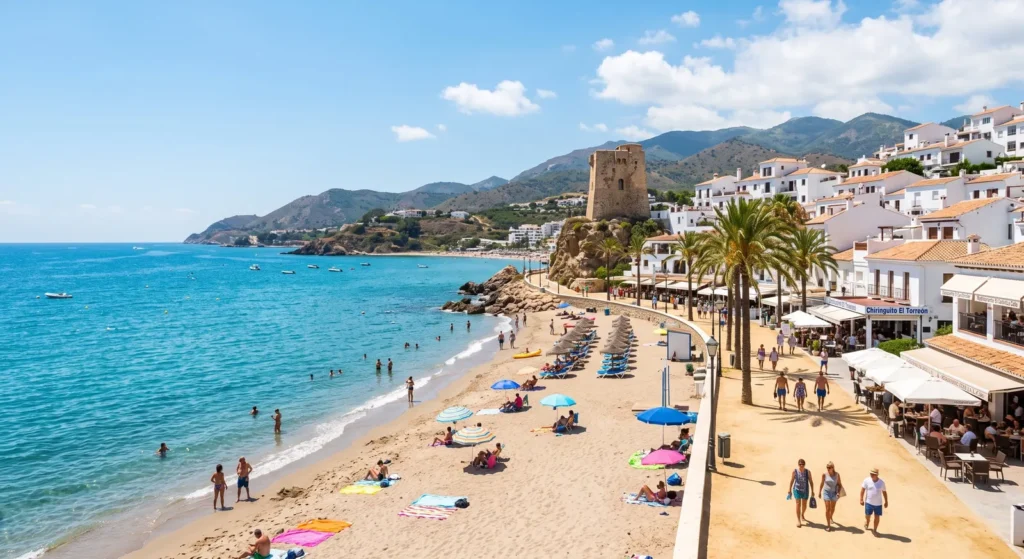
Things to Do in La Cala de Mijas: An Honest Local Guide
Things to do in La Cala de Mijas, written by locals: beach, promenade, market, Mijas Pueblo, golf and day trips. With kids, as a couple or solo