Booking a table in Spain: the call, the time and the card
You find the place. The photos look right, it's a ten-minute walk, you open the website looking for the booking button and there isn't one. There's a phone number and not much else.
If you come from a country where you haven't phoned a business in years, that moment feels like a wall.
In short
- A third of bookings in Spain are still a phone call, and the restaurant's own website beats every app.
- The call is three pieces of information: how many, when, and under what name.
- Málaga's median dinner booking is 20:45, so asking for a table at eight is no longer a foreigner's quirk.
- 21% of restaurants now take bank details as a guarantee, a practice FACUA considers abusive.
- Not turning up reads as rudeness. Cancelling takes eight seconds, by whatever route you booked.
What follows is what we'd tell a friend who has just landed on the Costa del Sol: how booking actually works here, what to say on the phone when your Spanish is thin, how far ahead you need to plan, and what to do on the day you can't make it.
The phone isn't dead: a third of bookings are still a call
In March 2026 CoverManager published Las Mesas Hablan, a report built on 78.4 million tables handled across Spain during 2025. Two splits come out of it:
- 62% of restaurant visits were booked in advance; the other 38% simply walked in.
- Of those bookings, 66% came in online and 34% by phone.
A third is far more than anyone arriving from the UK or the Nordics expects.
The biggest online channel is the restaurant's own website
The figure that actually helps you is a different one: the biggest online channel isn't a booking platform, it's the restaurant's own website.
In the first half of 2025 the restaurant's own site accounted for 59% of online bookings and Google for 37%, the latter growing 27% in a year. So before you open an app, search the name on Google and go to the restaurant's own page. There is often a form there that the platform never shows you.
The phone is the channel for groups
The phone isn't random either: phone bookings taken by staff average 4.6 people per table, against a general average of 3.24. If there are six of you, don't waste half an hour hunting for a button that was never there.
One 2025 detail worth knowing: 7% of phone bookings were already being handled by an automated voice assistant. If the voice on the other end speaks very slowly and repeats the same question twice, it isn't a waiter with a thick accent.
The call, in four sentences
The barrier is almost never the language. It's not knowing what's expected of you.
A phone booking in Spain is three pieces of information: how many, when, and under what name.
What to say
"Hola, buenas. Quería reservar una mesa para cuatro personas, para el sábado a las nueve. A nombre de Laura."
That's the whole thing. No apology for your accent required. If you stumble, "para cuatro, el sábado a las nueve" gets you there perfectly well.
What they'll ask you
- "¿A nombre de quién?" Whose name. If yours is hard to spell down a phone line, spell it out slowly or give a short one. Nobody checks ID at the door.
- "¿Me das un teléfono?" A phone number. Give a real one: it's the only way the restaurant can reach you if something changes.
- "¿Dentro o fuera?" Inside or out, meaning the terrace. On the coast that answer decides the whole evening.
- "¿Alguna alergia?" Any allergies. Say it now, not when you sit down. Once service is running it's far harder to work around.
If you lose the thread, "perdona, ¿me lo repites más despacio?" works far better than switching to English mid-sentence. And if it still isn't happening, ask whether you can send the booking in writing.
How far ahead, and the figure that doesn't add up
This needs honesty, because the published numbers contradict each other. TheFork's 2025 analysis says 63% of online bookings are made 24 hours or less before the meal.
But an earlier analysis from the same platform, covering January and February 2024, said the opposite: that 57% were made more than 24 hours ahead, up from 50% before the pandemic. The two don't reconcile, and we'd rather leave them both on the table than pick whichever suits the argument.
Where the calendar does work on a different scale is at the top end: at Michelin-starred restaurants, bookings made three to six months ahead have multiplied.
For everyday purposes, our own judgement
What follows is judgement rather than data, from living here:
- A neighbourhood place midweek: the same morning is plenty.
- Weekend in season: Thursday for Saturday. In July and August, earlier.
- Six or more, or a terrace with a view: a week, and confirm it.
- Christmas Eve, Valentine's, Mother's Day: weeks, not days.
The time you ask for and the time you'll get
The cliché that Spain eats at eleven at night is out of date, and there are numbers to prove it. CoverManager, comparing 2016 with 2026, found that Spanish diners have moved their average dinner time 56 minutes earlier over the decade.
The median booking time now is 20:00 Monday to Thursday and Sunday, and 21:00 on Friday and Saturday. In 2016, 31.5% dined before 21:00; in 2026 it's 56.9%.
The median, province by province
| Province | Median dinner booking time |
|---|---|
| Cádiz | 21:30 |
| Madrid | 21:00 |
| Málaga | 20:45 |
| Barcelona | 20:45 |
| Las Palmas and Santa Cruz de Tenerife | 20:15 |
Málaga's median of 20:45, three quarters of an hour earlier than Cádiz, changes the arithmetic for anyone on this coast: asking for a table at eight is no longer a foreigner's quirk. Asking for seven still is.
And if they offer you eight but want the table back by ten, that isn't rudeness, it's a second sitting.
When they ask for your card
It's becoming normal. TheFork's 2025 figures show 21% of restaurants now take bank details as a guarantee, double the 2023 share, and 7% charge up front, a practice that has tripled in two years.
It works. In a CoverManager analysis of Father's Day 2025, the absence rates came out like this:
- 1.92% on unprotected bookings.
- 1.52% with an SMS reminder.
- 0.66% with a card or advance payment.
Whether it's lawful is another matter
The Spanish consumer association FACUA considers the practice abusive, citing article 87 of Royal Legislative Decree 1/2007 of 16 November, which treats as abusive "the payment of sums for services not actually provided", along with compensation that doesn't match the damage actually caused.
The underlying argument is imbalance: you pay if you don't show, but the restaurant owes you nothing if it can't give you the table. FACUA does allow one exception, large groups cancelling at very short notice.
The sums aren't token. FACUA has filed complaints against El Invernadero in Madrid, which charged 100 euros for cancelling with less than 24 hours' notice, and against three venues of the Factoría Serendipia group in Seville, with charges of 10 to 20 euros.
This is a consumer association's position, not a court ruling striking those clauses down. Read the conditions before you confirm, and keep the message you cancelled with.
The no-show: here it reads as rudeness
Not turning up for a booking isn't filed here under "plans changed". It's filed under bad manners, and there's a reason.
The published rates disagree, and it's worth knowing why
TheFork puts the Spanish average at 3.3% in 2025, down from 3.6% in 2024, with Málaga right on the average and Seville highest at 3.7%.
CoverManager, across its own network, splits 2025 differently: 84% of bookings honoured, 14% cancelled in advance and 2% ghost bookings. And a Square survey of restaurant owners found 64% reporting up to ten absences a month, with 24.4% reporting more than ten.
They aren't measuring the same thing: two are percentages from different platforms, the third is a frequency reported by the operator.
It costs real money: for every 1,000 bookings, 33 empty tables and 2,584 euros unbilled, with the annual estimate drawn from TheFork's data at around 15,500 euros per restaurant.
Why people don't show
The reasons are the revealing part. In a 2025 TheFork survey, of those who failed to show:
- 55% said they had simply forgotten.
- 38% cited something unexpected.
- 7% admitted they were embarrassed to phone and cancel.
That 7% is almost certainly where the recent arrival who doesn't trust their Spanish recognises themselves.
Turn it around: cancelling isn't the rude part. Not cancelling is.
How to cancel properly
Cancelling properly takes eight seconds, by whatever route you booked. "Hola, tenía una reserva a nombre de Laura para esta noche y al final no vamos a poder ir. Lo siento."
And if there are fewer of you than you said, say so too: a table of six that arrives as three leaves three dead chairs on an August Saturday.
And there are consequences now that didn't exist before
Since late 2024 TheFork removes users who rack up four ghost bookings inside twelve months, and in 2025 it removed 2% of its Spanish users. CoverManager flags it when the same person books several restaurants in its network at once.
We cook Argentinian food over fire in La Cala de Mijas, and the rule doesn't change for a grill house: the fire needs to know how many of you there are and when.
More news
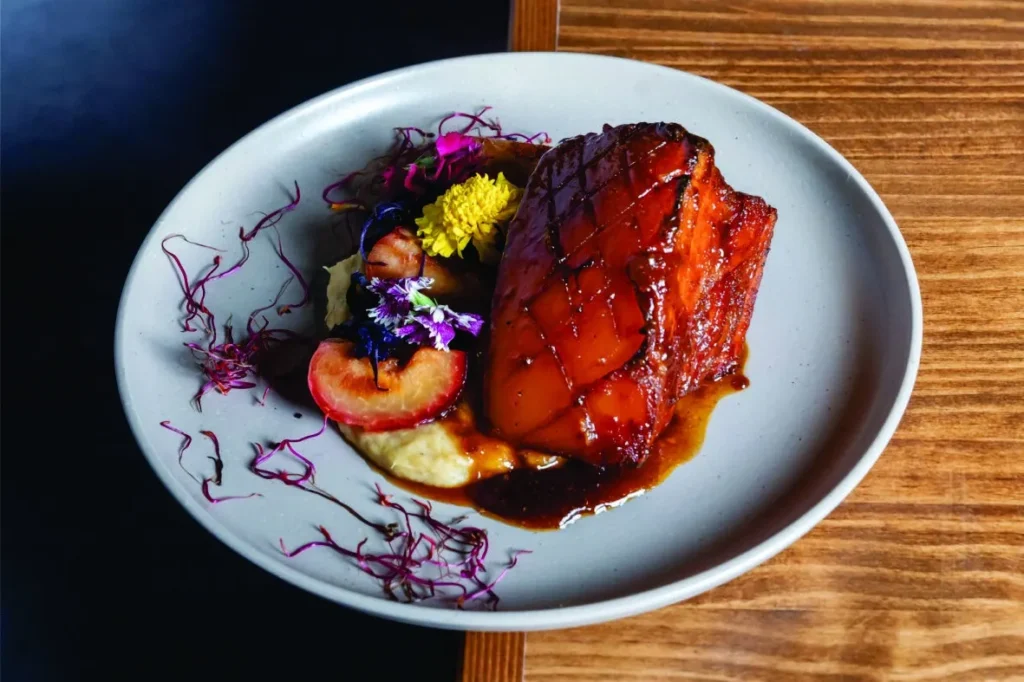
Bife de Chorizo: the Argentine Cut With No Chorizo In It
Bife de chorizo contains no chorizo. Where the cut sits, how it differs from ojo de bife, why sirloin is a trap, and what live coals do to it on the grill.
What to See in Benalmádena: Three Towns and One Smart Day
What to see in Benalmádena without losing the day to the car: Colomares, the Stupa and Calamorro sorted by centre, plus the hours worth checking first.