Bife de Chorizo: the Argentine Cut With No Chorizo In It
Let's clear up the thing that brought most people here: bife de chorizo contains no chorizo. Not a gram.
It doesn't come with chorizo, it isn't cooked with chorizo, it has nothing to do with the sausage. It's a beef cut, plain and simple, one of the staples of the Argentine grill, and the misunderstanding is so persistent it's worth settling before the waiter arrives.
In short
- It's a beef cut, the bife angosto, sitting over the six lumbar vertebrae. No bone, no sausage.
- It is not the ojo de bife: that one comes off the dorsal vertebrae and the ribs, and it's fattier.
- In the UK it's sirloin steak, in the United States the New York strip, and at a Spanish butcher's lomo bajo.
- It's cut three to four centimetres thick and a portion runs 300 to 400 grams, more than double a Spanish entrecot.
- Hot coals to sear, then medium. It's a muscle that does little work, and long cooking ruins it.
What follows is the fine detail: where that muscle sits, what your butcher calls it on this coast, and what live coals do to it.
Where the name comes from
The honest answer: nobody knows for certain. The blog of the Argentine meat packer Frigorífico SADA says so outright, that the origin is a mystery with no definitive explanation. Two theories keep coming back.
The shape one: separated from the ribs, the muscle is long and roughly cylindrical, not unlike a sausage, which is the version given by the Argentine site Carnes.com.ar and by Ayelén Iñigo's text published by Gustar on Google Arts & Culture.
And the Argentinism one, also in SADA, deriving it from beef or beefsteak by the same route that turned "beef" into "bife".
They agree on what matters when ordering: no sausage involved. Gustar adds a dated fact: the cut was popularised by La Cabaña, a restaurant opened in 1935 on Avenida Entre Ríos in Buenos Aires.
Exactly where it sits on the animal
Here there's a hard source. The manual of the osteo-muscular components of beef cuts, written for Argentina's SENASA by Dr Ismael O. Delprato, professor of Anatomy at the National University of La Plata, places the bife angosto — the technical name for bife de chorizo — over the corresponding half of the six lumbar vertebrae. Not a single rib.
It is made up, from the outside in, of:
- The aponeurosis of the latissimus dorsi.
- Beneath it, the spinalis.
- The longissimus dorsi.
- The iliocostalis.
- The dorsolumbar interspinalis.
The longissimus dorsi, the muscle that changes name
The star is the longissimus dorsi, and that explains half this article. It runs along the spine next to the vertebrae and changes name depending on the stretch.
As Wikipedia's entrecôte entry notes, above the rib cage it is one thing and, past the rib cage, alongside the lumbar vertebrae, it becomes what the French call contre-filet and the English-speaking world calls sirloin or strip steak.
Bife de chorizo is that second stretch. It is also a muscle that does little work — Wikipedia's own phrase — which is where the tenderness comes from, and why long cooking ruins it.
Bife de chorizo and ojo de bife are not the same cut
This is the confusion we see most often at a table, and it comes apart if you look at the bones. The same SENASA manual places the bife ancho — the source of the ojo de bife — over the eight dorsal vertebrae following the fifth, plus roughly twelve centimetres of the last eight ribs. It sits among the ribs; bife de chorizo sits behind them.
| Bife de chorizo | Ojo de bife | |
|---|---|---|
| Area | Six lumbar vertebrae | Dorsal vertebrae and ribs |
| Bone | Boneless | May be bone-in |
| Fat | Lateral, a fat cap | Intramuscular, marbled |
| Texture | Firmer, even flavour | Fattier, more intense |
| Export name | Striploin | Cube roll or ribeye roll |
Bone, fat and texture come from the Carnes.com.ar comparison; the export names from the Argentine Beef catalogue, which ships the bife angosto at one, three or four ribs — so the commercial piece reaches slightly into the thoracic area, and two bifes from the same animal are not identical.
In Guía Repsol, grill cook Brichetto adds where the other name comes from: the ojo de bife is circular, very round.
Marbling and thickness
On marbling it's worth being honest, because the sources disagree: Certified Angus Beef calls the strip steak lean and reserves "generous marbling throughout" for the ribeye, while the US Beef Checkoff describes the strip loin as well-marbled.
Breed and finishing weigh as much as the cut itself: don't expect ribeye veining, but don't write it off as lean either.
The fat cap, and the thickness
What is constant is the lateral fat cap, the white band along one edge, which one of our references puts at five to eight millimetres.
And then there's thickness, which is where the real gap opens up with what a British diner knows. Bife de chorizo is cut three to four centimetres thick and a single portion weighs 300 to 400 grams. A Spanish entrecot, per EROSKI Consumer's beef guide, is a thick boneless steak off the lomo bajo of around 150 grams.
Same muscle, less than half the meat. That shows up on the plate far more than the name does.
What to call it where you buy meat
The sirloin trap
If you're British, you already eat this cut: in the UK, Canada, South Africa, Australia and New Zealand it is sold as sirloin steak. In the United States the same piece is the New York strip, and also the Kansas City strip, club steak or ambassador steak.
And there's the trap, because sirloin does not mean the same thing on both sides of the Atlantic. Wikipedia puts it plainly: what British butchery classifies as sirloin, American butchery files under the short loin, and what the Americans call sirloin is what the British call rump — a cut made up mostly of the gluteus medius, with nothing to do with the loin. If a sirloin arrives looking unfamiliar, this is usually why.
At a Spanish butcher's
Guía Repsol is clear: in Spanish butchers' shops bife de chorizo is lomo bajo, or entrecot, and ojo de bife is lomo alto. That fits the Spanish breakdown described by EROSKI Consumer, where lomo alto is the section nearer the neck, with the long ribs, and lomo bajo the section nearer the hind leg, with the lower or kidney ribs. Ask for lomo bajo and you'll get it.
One warning, though. Directo al Paladar, in August 2026, calls bife de chorizo lomo alto even while placing it in the lumbar area in the same sentence, and some Argentine restaurant sites equate it with ribeye outright. The SENASA anatomy points the other way.
Describe the piece rather than trusting the label.
Why no equivalence is exact
Because every tradition saws the carcass in different places. The Argentine short loin specification spells it out: the backbone is sawn at the lumbar joint and, at the other end, between the fifth and sixth dorsal vertebrae.
Where an Argentine butcher makes the cut, a Spanish one makes another. Add thickness, portion size and how much fat cap is left on, and the equivalence becomes useful for shopping, not for assuming two plates will be alike.
What the coals do to it
A muscle that barely works doesn't need time, it needs heat. The Argentine sources agree on the sequence: hot coals to sear, three or four minutes, then finish over medium coals; another gives four to six minutes a side depending on thickness.
Always hot first, gentler after, which is what stops the fat cap burning before the centre is ready. The rest they all repeat:
- Out of the fridge thirty to forty-five minutes ahead.
- Coarse salt just before it goes on.
- Two to five minutes' rest afterwards.
Turn it once, or turn it often
The real argument is over something that sounds like dogma: turning it only once. All three Argentine references recommend it.
But in October 2026 the Argentine outlet Canal 26 gathered the opposite position from two heavyweights: Heston Blumenthal, who at the Margaret River Gourmet Escape festival recommended turning the steak every ten or fifteen seconds, and J. Kenji López-Alt, author of The Food Lab, who told Eater that frequent turning cooks more evenly and cuts the time by around thirty per cent.
Both argue the same thing: alternating heat keeps the surface from burning before the centre gets there. At three or four centimetres that argument carries weight, because the centre is exactly the problem.
How to order it
With numbers, the only way to be understood. The Certified Angus Beef chart sets:
- 52 °C for rare.
- 57 °C for medium rare.
- 63 °C for medium.
- 66 °C for medium well.
And it adds what almost nobody allows for: pull the steak a couple of degrees below target, because the temperature keeps climbing as it rests.
And the figure you won't see on any menu: the USDA's food-safety minimum for whole cuts of beef is 62.8 °C with a three-minute rest, so the jugoso most people order — the doneness Argentines favour, per Gustar, because it brings out the flavour — sits below that official threshold.
The shortcut
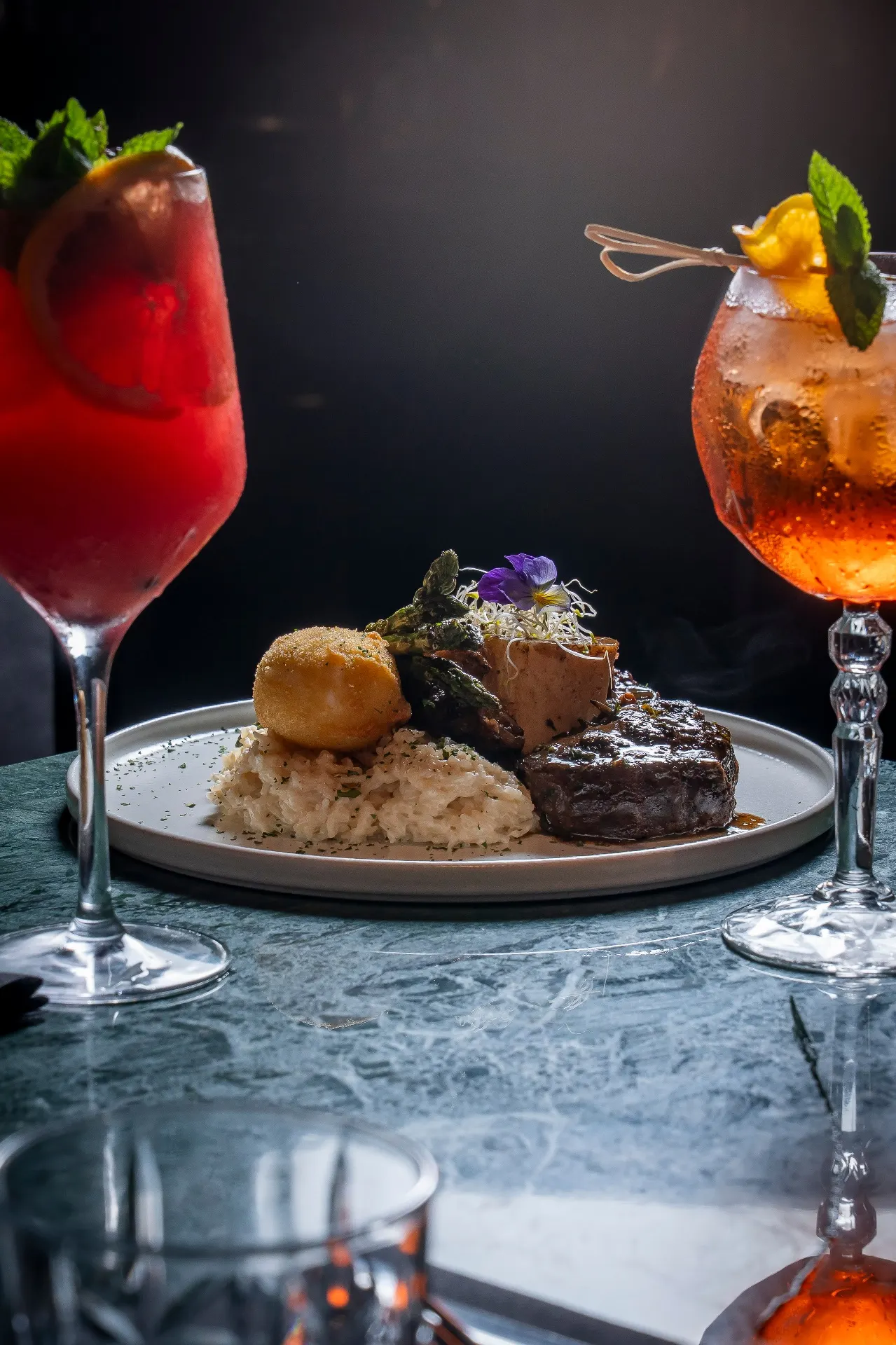
Describe the result rather than naming a doneness. "Red in the middle, but hot" works in any kitchen. At Pauza, where we cook Argentine food over fire in La Cala de Mijas, that sentence is worth half a menu.
More news
Booking a table in Spain: the call, the time and the card
Booking a table in Spain still means phoning a third of the time. What to say in Spanish, how far ahead to plan, and why a no-show here reads as rudeness.
What to See in Benalmádena: Three Towns and One Smart Day
What to see in Benalmádena without losing the day to the car: Colomares, the Stupa and Calamorro sorted by centre, plus the hours worth checking first.