
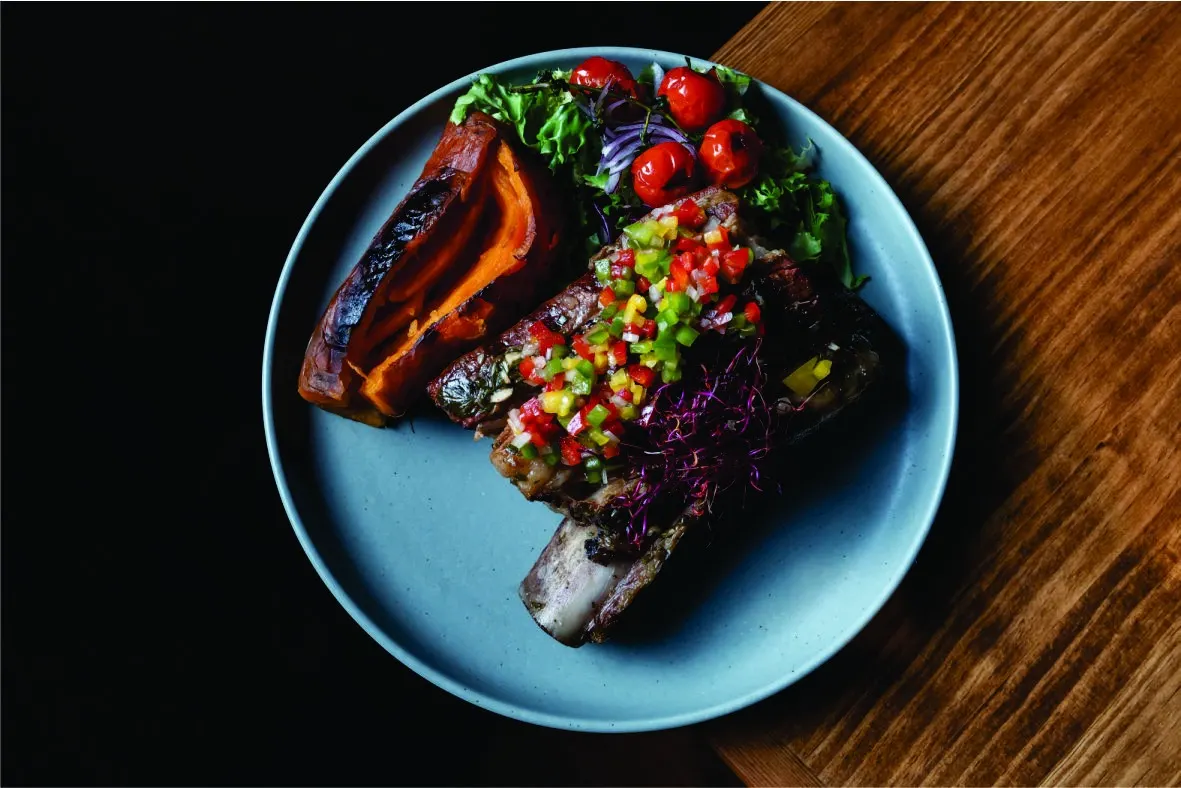
Argentine asado vs Spanish barbecue: why it tastes different
If you have been on this coast a while, you have probably had the Spanish version done properly: a chuletón buried in coarse salt, fifteen minutes over fierce charcoal, the middle still red.
Then you walk into an Argentine parrilla expecting the same and something else arrives. Not worse, not better. Different. And what changes is not the beef, it is how the fire is managed.
In short
- Time is the big difference: about fifteen minutes for a chuletón, one to three hours on an Argentine parrilla.
- Quebracho colorado burns slow and steady; Spanish asadores lean on charcoal, which arrives already as embers.
- V-shaped bars carry the fat away from the fire; round rods let it drop, smoke and flavour the meat.
- The cuts do not translate: bife ancho is lomo alto, and asado de tira has no direct Spanish equivalent.
- Chimichurri is not a marinade. An adobo goes in before cooking; chimichurri goes on top afterwards.
This is not about which one wins, a question that goes nowhere, but about what actually changes from one tradition to the other and why it shows up on the plate. We have written separately about the philosophy of our own fire and about the Argentine cuts; this is what happens between the wood and the meat.
The clock: fifteen minutes against three hours
Time is the biggest difference, and almost everything else follows from it.
What a chuletón asks for
Grill master Iñaki Gorrotxategi puts his ideal chuletón at 1,000 to 1,200 grams and "two fingers high, around 4 centimetres" thick: it comes up to room temperature over two or three hours until it reaches 20-25 ºC, then cooks in about fifteen minutes.
He wants 48 ºC in the centre, for a charred outside, a thin band of transition and a middle that is red, raw but hot.
What an Argentine parrilla asks for
On an Argentine parrilla the clocks read differently:
- 60 to 90 minutes for a rack of short ribs.
- 90 to 120 minutes for vacío.
- 30 to 45 minutes for matambre.
- 20 to 30 minutes for entraña.
A whole rib cage on the cross, the format for celebrations, takes around three hours, an hour and a half to two on the bone side and roughly 45 minutes on the other, with the cross angled at close to 60 degrees.
In a Basque asador the fire is a single strike; on an Argentine parrilla it is a long conversation.
Embers, never flame: the fuel decides
Three hours of cooking need a fuel that lasts.
The Argentine woods
- Quebracho colorado, the reference wood for Argentine asado, has a density of around 1,200 kg/m³ and a calorific value of roughly 4,500 kcal/kg: slow to light precisely because it is not very porous, but steady once it is.
- Algarrobo gives embers faster and is kept for thin cuts such as entraña.
- Vine prunings, sarmientos, catch instantly and are light ash within minutes: good for lighting and aroma, useless for holding heat.
Spain tends to start somewhere else
Go through the well-known Spanish asadores and charcoal keeps appearing: holm oak, carrasca, charcoal combined with oak wood. Charcoal arrives already as embers; firewood has to be converted, which is why an Argentine parrilla needs a brasero working off to one side.
There is crossover: Madrid has grill houses that make their own embers in a forged cradle, burning holm oak, white quebracho or marabú.
The principle holds on both sides of the Atlantic: embers, not flame, and with charcoal the signal is the grey ash coating, which takes 20 to 30 minutes.
The grill itself: V-shaped bars against round rods
Here is the technical detail almost nobody explains, and it decides much of the flavour: what happens to the fat the meat releases.
The classic Argentine parrilla uses V-shaped iron bars, a channel that catches the fat and runs it off into a container so it never hits the fire. Round-rod grills do the opposite: fat drops straight onto the embers, makes smoke and gives a far more pronounced flavour, which is why they suit lean cuts.
The angled Basque grill plays in the same territory; Gorrotxategi explains that the tilt stops so much fat falling into the flame. Not folklore: in Madrid you will find grill houses using V-bars for everything and others deliberately choosing round rods, "like the Basque one, not in a V".
Height, and a warning about the scales
Height is adjustable too. The most commonly cited recommendation puts the grill 12 to 15 centimetres above the embers, with the palm of your hand as the thermometer.
One warning, because the scales do not agree between sources. Buenos Aires city tourism gives:
- 1-2 seconds for a hot fire (170-200 ºC).
- 3-4 seconds for moderate (120-170 ºC).
- 5-8 seconds for gentle (90-120 ºC).
Other guides call 5 seconds hot and 7 seconds medium. Trust the look of the embers, red with a grey rim, more than any mental stopwatch.
And the cross is not a grill at all
The cross, or stake, is not a grill at all: the piece stands upright facing the fire and takes the heat sideways and indirectly, which is what lets a rib cage sit there for hours without burning.
The cuts do not translate
Half the confusion at the table comes from the menu: the names do not line up. The most useful rough equivalences:
| Argentina | Spain | What it is |
|---|---|---|
| Bife ancho | Lomo alto | Where chuletones and ribeyes come from |
| Bife angosto | Lomo bajo | Further back, sirloin end |
| Lomo | Solomillo | Fillet, the lean piece |
| Asado de tira | No direct equivalent | Rib cut across the bone, with the intercostal meat |
| Vacío | Falda, aleta | Flank, lower and lateral |
| Matambre | Falda, tapa fina | Thin sheet over the rib cage |
| Entraña | Entraña | Skirt, from the diaphragm |
Watch out for asado de tira: it is not a rack cut between the bones, it is the rib sawn across. The thickness changes, the exposed surface changes, and so does the time.
And the animal is not the same either
Argentine grilling beef is associated with Angus and Hereford raised outdoors, grass as the base of the diet, little intramuscular fat and shorter ageing.
The Spanish chuletón pulls the other way: old cows of 6 or 7 years, sometimes 5 to 12, from breeds such as rubia gallega, avileña-negra ibérica or retinta, aged 15 to 30 days in most houses and stretched to 45-90 or even 70-120 in some.
More age and more ageing give a more intense flavour; grass and short ageing give a cleaner one. Your palate arrives trained for one and is handed the other.
Salt: the one point nobody agrees on
Salt is where you can tell asado is an oral trade rather than an instruction manual. Argentine sources openly contradict each other: Buenos Aires city tourism recommends coarse salt after the initial sear, other guides salt at the start, others accept either. Worth testing on your own grill before taking anything as settled.
The salmuera, which is not a marinade
What is specifically Argentine is the salmuera: it goes on during the cook, not before. Two level tablespoons of coarse salt per cup of hot water (250 ml), with ground chilli, sweet paprika and pepper, brushed on in two or three passes as the meat cooks.
It salts in thin layers while the piece is on the fire.
The Spanish gesture is different
And more generous than people expect. Gorrotxategi covers the chuletón in coarse sea salt for the whole cook and removes it before it goes to the table, where Maldon is offered separately. Other houses salt each face as they grill it, or only one side at the end.
If you have seen a steak buried under salt and thought it madness, it was not: that salt is not eaten.
Chimichurri is not a marinade
The most common misunderstanding of all.
What an adobo does
A Spanish adobo mixes oil, vinegar, salt and spices (paprika, garlic, oregano) and works before cooking, with steeping times from ten minutes for red meat to one hour, two or even eight depending on the piece.
It began as preservation and now does flavour and juiciness. It goes into the meat.
What chimichurri does
Chimichurri does the opposite. Fresh parsley, oregano, garlic, ground chilli, vinegar and oil, usually three parts oil to one of vinegar, and it needs resting: with fresh garlic, four hours minimum, ideally twelve to twenty-four.
But it is always served after cooking, over the sliced meat. Put it on the grill and the vinegar evaporates while the parsley burns.
Even its origin is unsettled, with Basque roots claimed (tximitxurri, "a mixture of things in no particular order") alongside Quechua ones.
In one line: adobo goes in, chimichurri sits on top.
That is why it reaches the table in a bowl rather than already brushed on.
How to order without being disappointed
Three pieces of advice, whether you are eating at Pauza or at any other Argentine grill house in La Cala de Mijas.
- Do not order the doneness you would ask for on a chuletón. The Argentine point is one notch past medium rare, pink and juicy in the middle. Asking for rare out of habit tends to disappoint on the long-cooked cuts.
- Respect the running order. Offal first, short ribs next, the big cuts last: chorizos and ribs open with 45 to 60 minutes, sweetbreads join with 20 to 30, and blood sausage closes with 10 or 15 to warm and colour. If everything lands at once, something is off.
- Give the kitchen time. A vacío can spend two hours on the grill. That is not slow service, that is the dish.
The rest takes care of itself. The meat arrives, the chimichurri arrives separately, and the evening stretches because the fire has set the pace for hours.
More news
What to See in Benalmádena: Three Towns and One Smart Day
What to see in Benalmádena without losing the day to the car: Colomares, the Stupa and Calamorro sorted by centre, plus the hours worth checking first.
Costa del Sol in Winter: The Numbers Nobody Tells You About
The Costa del Sol in winter: 914 hours of sunshine and under 27 rain days from November to March. Here are the AEMET figures and what truly changes here.